
What is Cubipod?
| Advantages CUBIPOD has over: | |
|---|---|
| CUBIC BLOCKS (2 LAYERS) | BULKY BLOCKS (1 LAYER) |
| Reliable single-layer armors | Much higher structural strength |
| Much higher hydraulic stability | Unit size and armor depth not limited |
| Lower run-up and overtopping rates | Concrete quality not critical |
| No face-to-face arrangements | Safe and efficient handling using pressure clamps |
| Higher frictions with the underlayer | Easy casting with vertical moulds |
| Smaller rocks in the underlayer | High production rates (2-3 units/day/mould) |
| Much lower concrete consumption | Multi-level stacking in block yard |
| Low energy and carbon footprint | Easy random placement (8-12 units/hour) |
| Higher armor randomness | Workers do not need to be as highly qualified |
| Uniform armor porosity | |
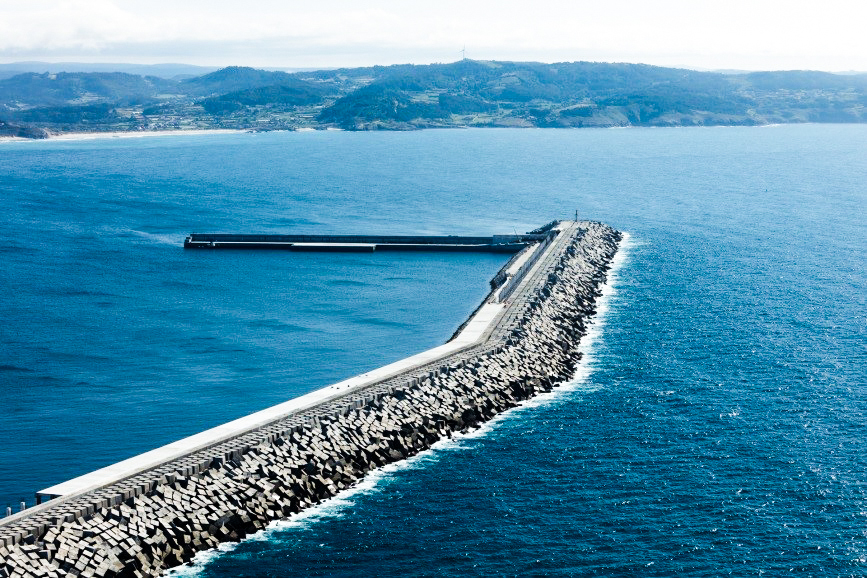
It is customary for large mound breakwaters in Spain and other countries to have a double-layer of cubic blocks placed randomly. Cubic blocks are highly resistant and have considerable logistical advantages over other more slender units. However, cubic blocks are fraught with certain major defects when used as armor units:
— From a hydraulic perspective they are rather unstable.
— They tend to be arranged face-to-face, generating heterogeneous compaction processes that weaken the breakwater and increase the overtopping discharg.
— One face tends to be placed parallel to the slope generating little friction with the underlying layer.
— It is not easy to achieve an initial placement that seems random and it is impossible in the long term because the adaptation is liable to take place face-to-face.
— They cannot be placed randomly in one single layer because of the serious long-term changes affecting porosity.
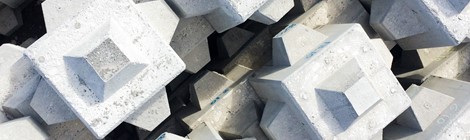
A new element called Cubipod has been developed in order to overcome the shortcomings affecting conventional cubic blocks, while retaining their logistical advantages.
Evolution from Cube to Cubipod
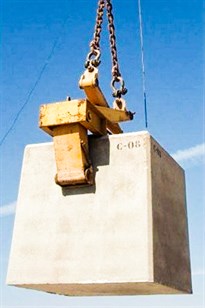
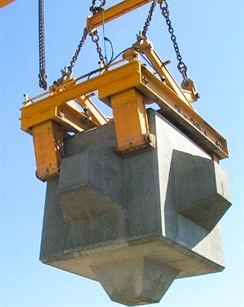
Cubipod has been devised to neutralize the drawbacks afflicting the cubic block while conserving its advantages. Its cube-shaped design with protuberances on its faces prevents the pieces from adopting a self-packing arrangement and increases friction with the underlying layer. The square pyramidal trunk shape of its protuberances is ideal for preventing flexures and torsions in the impact that the piece might be subjected to while a breakwater is being constructed. Furthermore, the size of the protuberances is similar to the size of the holes between the rocks on the lower layer on which it is laid, which makes it possible to increase the friction between the armor and the underlying layer. Pressure clamps are used to handle Cubipod and they do not require much storage space as the pieces still have a considerable cubic core.